Executive Summary
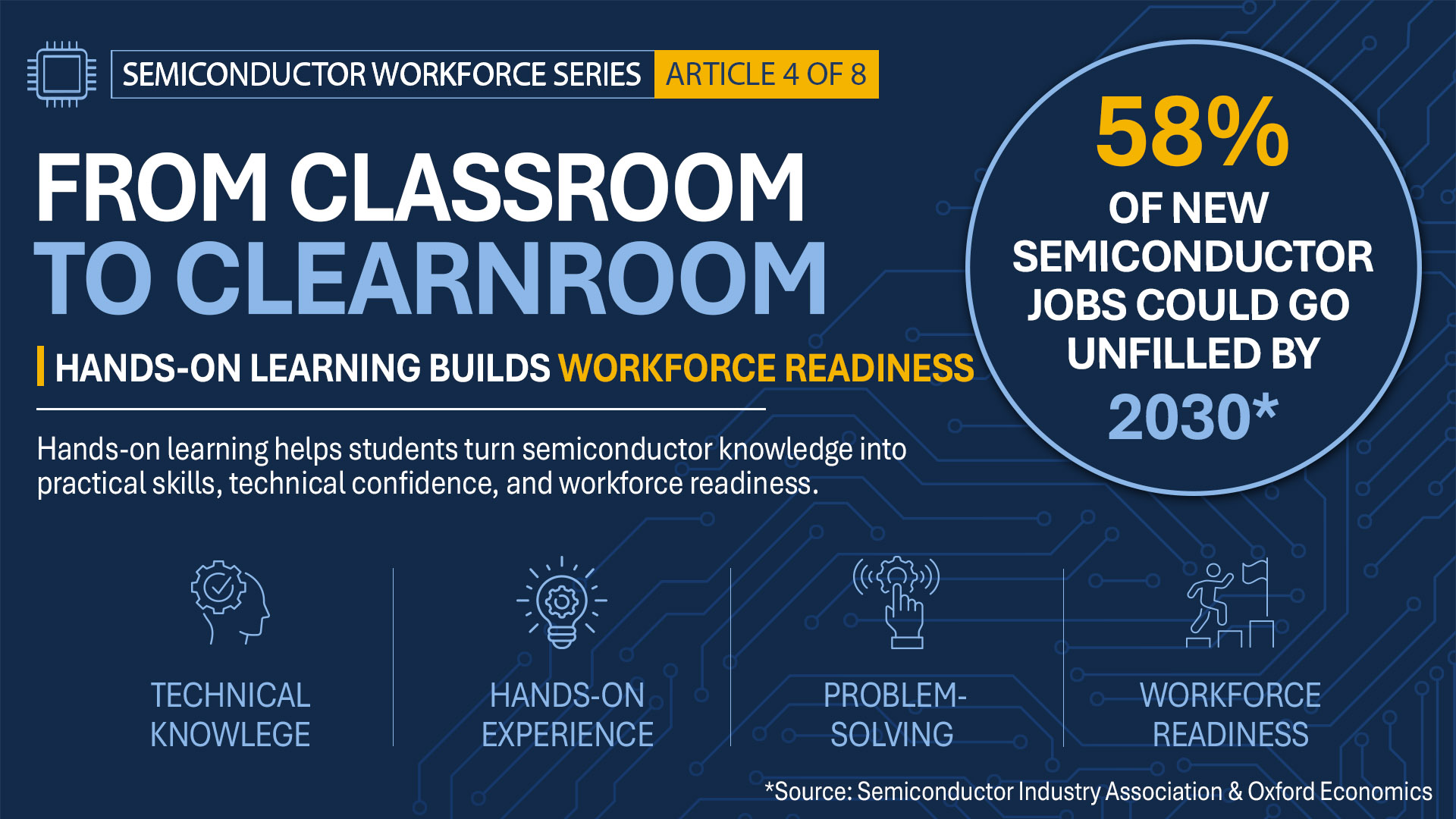
Hands-on semiconductor education turns technical knowledge into practical capability. When students take measurements, follow procedures, interpret process data, diagnose faults, make adjustments, and learn from mistakes, they develop technical judgment that theory alone cannot provide. The strongest workforce programs connect classroom instruction with meaningful experience so graduates understand not only how technology should work, but how to respond when it does not.
Table of Contents
- Why Is Hands-On Learning Essential in Semiconductor Education?
- What Can Students Learn Through Experience?
- Why Are Troubleshooting and Productive Mistakes So Important?
- How Do Realistic Training Environments Build Confidence?
- How Does Hands-On Learning Bridge the Classroom and Workplace?
- How X-Cal Helps Bridge the Classroom and Workplace
- Conclusion
- One Final Thought
- Frequently Asked Questions
- Next in the Semiconductor Workforce Development Series
Why Is Hands-On Learning Essential in Semiconductor Education?
A student can understand Ohm's Law without holding a multimeter. They can explain how a sensor works without installing one, describe an automated process without troubleshooting it, and earn an excellent grade without determining why a real system stopped working. Those accomplishments matter because technical knowledge is the foundation of a successful career. Semiconductor manufacturing, however, eventually asks employees to do something more difficult than explain what should happen: it asks them to determine what happened when it did not.
Modern semiconductor manufacturing depends on precision, reliability, safety, contamination control, and tightly managed processes. The technicians supporting these environments must be able to observe system behavior, compare it with expected operation, interpret measurements and alarms, identify possible causes, test those possibilities, and verify the result.
Those abilities are difficult to develop through theory alone. Hands-on learning moves students beyond knowing the correct answer and teaches them how to find it. Learners begin to see how components interact within larger systems: a sensor affects a controller, the controller affects an actuator, and a problem in one area can create symptoms somewhere else.
Key Takeaway
Technical knowledge teaches students how systems should work. Hands-on experience teaches them what to do when they don't.
This does not diminish classroom instruction. Strong fundamentals make hands-on learning more valuable because students can connect what they learned conceptually with what they observe physically. When students learn a principle, apply it, examine the result, and determine why the result may differ from expectations, they begin to understand how to work with technology rather than simply describe it.
What Can Students Learn Through Experience?
Textbooks explain principles, diagrams show relationships, lectures communicate accumulated knowledge, and simulations help students visualize processes that may be difficult or unsafe to reproduce. Each has an important role. The opportunity is to combine them with experience so students can apply technical concepts when the answer is not immediately obvious.
Consider taking an electrical measurement. A student may understand voltage on paper, but using a meter correctly requires more. The student must decide where to measure, know what value to expect, recognize what an unexpected reading might mean, question whether the measurement is reliable, and determine what to check next. The electrical principle has not changed; the student is now using it to make a decision.
The same progression occurs throughout semiconductor and advanced manufacturing education. Students may interpret pressure, temperature, flow, or vacuum readings; configure sensors and controls; follow contamination-control procedures; examine the interaction between pneumatic, electrical, and automated systems; or document an abnormal condition and verify that corrective action restored proper operation.
Through these experiences, students learn to follow technical procedures, use tools and test equipment correctly, interpret documentation, recognize abnormal conditions, diagnose faults systematically, verify results, and explain their reasoning. Together, these skills develop something that is difficult to measure on a written exam: technical judgment.
In production, problems rarely arrive neatly organized around the chapter being studied. They appear as alarms, unexpected measurements, intermittent faults, abnormal equipment behavior, inconsistent process results, or systems that refuse to operate as expected. Preparing students for that reality means giving them opportunities to experience it before their first day on the job.
Why Are Troubleshooting and Productive Mistakes So Important?
One of the greatest benefits of hands-on education is that equipment does not always behave as expected. A connection may be incorrect, a component may be misconfigured, a sensor may produce an unexpected reading, or a student's first assumption may be wrong. In production, those situations can cause delays, quality problems, or safety concerns. In a properly designed learning environment, they can become valuable lessons.
Troubleshooting requires students to combine technical knowledge with observation, logic, patience, and disciplined problem-solving. They must define what the system should do, compare that expectation with what is happening, gather evidence, test likely causes, and verify the correction. This builds a repeatable approach that can transfer to equipment and problems they have never seen before.
Industry Insight
Workforce readiness is not demonstrated only when everything works. It is demonstrated when something goes wrong and the learner knows how to begin finding out why.
A classroom also provides room to learn from mistakes without risking production. Students can discover why an incorrect diagnosis failed, reconsider the evidence, test another possibility, and recover from uncertainty while an instructor is available to guide the process. This does not encourage carelessness. It teaches students why procedures, documentation, verification, and thoughtful questions matter.
The objective is not to expose students to every failure they may encounter. No curriculum could anticipate them all. The objective is to prepare students to approach unfamiliar problems with enough knowledge, confidence, and discipline to begin finding the answer.
How Do Realistic Training Environments Build Confidence?
Technical confidence should not come from believing you already know every answer. It should come from knowing how to respond when you do not. That confidence develops through repetition and the gradual realization that unfamiliar problems can be solved through a disciplined process.
At first, a malfunctioning system may feel overwhelming. With practice, students become more comfortable using tools, interpreting measurements, following procedures, recognizing patterns, questioning assumptions, consulting documentation, and working through problems systematically instead of reacting to the first symptom.
Schools do not need to reproduce an entire semiconductor fabrication facility to create these experiences. The goal is to replicate the decisions, procedures, equipment interactions, precision, and problem-solving behaviors students will encounter in industry. A learning system can teach valuable semiconductor workforce skills when students must observe conditions, take measurements, configure components, diagnose faults, correct problems, verify results, and explain their reasoning.
The value of a training environment should therefore be measured by more than how impressive the equipment looks. Its real value is determined by what students are required to do with it.
How Does Hands-On Learning Bridge the Classroom and Workplace?
Moving from education into a production environment brings a new level of responsibility. Equipment is no longer operated only for instruction. Decisions can affect safety, uptime, process quality, contamination risk, and the customer. Technicians must also understand how their work fits within a larger manufacturing process.
Hands-on education makes that transition less unfamiliar by helping students develop practical habits before they enter the workplace. Graduates who have already followed procedures, interpreted documentation, taken measurements, diagnosed faults, documented observations, collaborated with others, and verified results are better prepared to build on an employer's training.
Workforce readiness should not be confused with knowing how to operate one specific machine. Semiconductor equipment varies by manufacturer, facility, and process, and it will continue to change throughout a technician's career. Education cannot prepare students for every system. It can prepare them to enter unfamiliar environments with strong fundamentals, practical experience, disciplined work habits, and the confidence to continue learning.
Workforce Perspective
The goal is not to make the classroom identical to the cleanroom. It is to make the transition between them less unfamiliar.
Employers expect to teach company procedures, proprietary processes, specialized equipment, and site-specific requirements. The strongest graduates arrive ready to build on that training rather than begin their practical education from scratch.
How X-Cal Helps Bridge the Classroom and Workplace
X-Cal works with educators, workforce organizations, and industry partners to help prepare students for semiconductor manufacturing, advanced manufacturing, and other high-demand technical careers. A central principle guides that work: students build confidence when they have meaningful opportunities to apply what they learn.
Effective hands-on education requires more than placing equipment in a lab. Technology, learning objectives, instructor support, and practical exercises must work together so students learn to observe, measure, diagnose, solve problems, and understand why systems behave as they do.
X-Cal helps schools make those connections by bringing industry-relevant technologies and practical learning experiences into educational environments. These environments give students opportunities to work with the principles, equipment interactions, procedures, measurements, and problem-solving processes associated with semiconductor and advanced manufacturing while helping instructors turn technology into meaningful student experiences.
The objective is not to train students for one machine or one employer. It is to build transferable knowledge and practical capability that graduates can continue developing as technologies, roles, and workplaces evolve.
Conclusion
America's semiconductor workforce challenge cannot be solved simply by attracting more people into technical careers. Students who choose those pathways also need opportunities to develop the practical capabilities required to succeed in the workplace.
Classroom instruction provides the foundation. Hands-on learning tests that knowledge against operating systems, measurements, procedures, unexpected results, and problems that require judgment rather than memorization. Together, those experiences build technical understanding, problem-solving ability, confidence, and the willingness to continue learning.
No classroom can reproduce every environment graduates will enter, and no curriculum can anticipate every problem they will face. The strongest programs do not try to. They prepare students with the fundamentals to understand what they are seeing, the experience to begin working through unfamiliar problems, and the discipline to keep developing throughout their careers. That is how education closes the distance between the classroom and the cleanroom.
One Final Thought
There is a moment in technical education when a diagram becomes a system a student can operate, a principle becomes a measurement they can verify, and a problem they once would have handed to an instructor becomes something they are willing to investigate themselves. That moment is the beginning of technical confidence.
The semiconductor workforce America needs will be developed when knowledgeable instructors, strong technical foundations, industry-relevant technologies, and meaningful hands-on experiences come together—helping students turn what they know into what they can do.
Frequently Asked Questions
It allows students to apply technical concepts while working with equipment, measurements, procedures, and problems that require practical decisions. These experiences develop technical judgment, confidence, and problem-solving ability.
Classroom instruction provides essential technical foundations. Practical experience helps students apply those principles when equipment or processes do not behave as expected. Strong programs combine both.
Troubleshooting teaches students to compare expected and actual behavior, gather evidence, test possible causes, and verify results. A repeatable process is more valuable than memorizing solutions to individual faults.
No. Schools can build valuable skills by focusing on relevant principles, procedures, measurements, equipment interactions, process variables, safety, contamination discipline, and systematic problem-solving.
Students should do more than watch equipment operate. They should follow procedures, observe conditions, take measurements, interpret results, diagnose problems, make corrections, verify operation, and explain their reasoning.
X-Cal helps institutions connect educational technology, practical learning environments, and workforce-focused training objectives to help students develop the technical judgment, problem-solving skills, and hands-on experience needed for advanced manufacturing careers.
Next in the Semiconductor Workforce Development Series
Article 5: The Modern Semiconductor Technician — The Skills That Power Advanced Manufacturing
Hands-on experience turns technical knowledge into practical capability, but what capabilities will tomorrow's semiconductor technicians need? The next article examines the technical, analytical, and professional skills required to support increasingly sophisticated manufacturing environments—and why the modern technician must understand more than any single technology or system.