The Future of the Semiconductor Workforce
A Blueprint for America’s Next Generation of Innovation | Article 8 of 8
Executive Summary
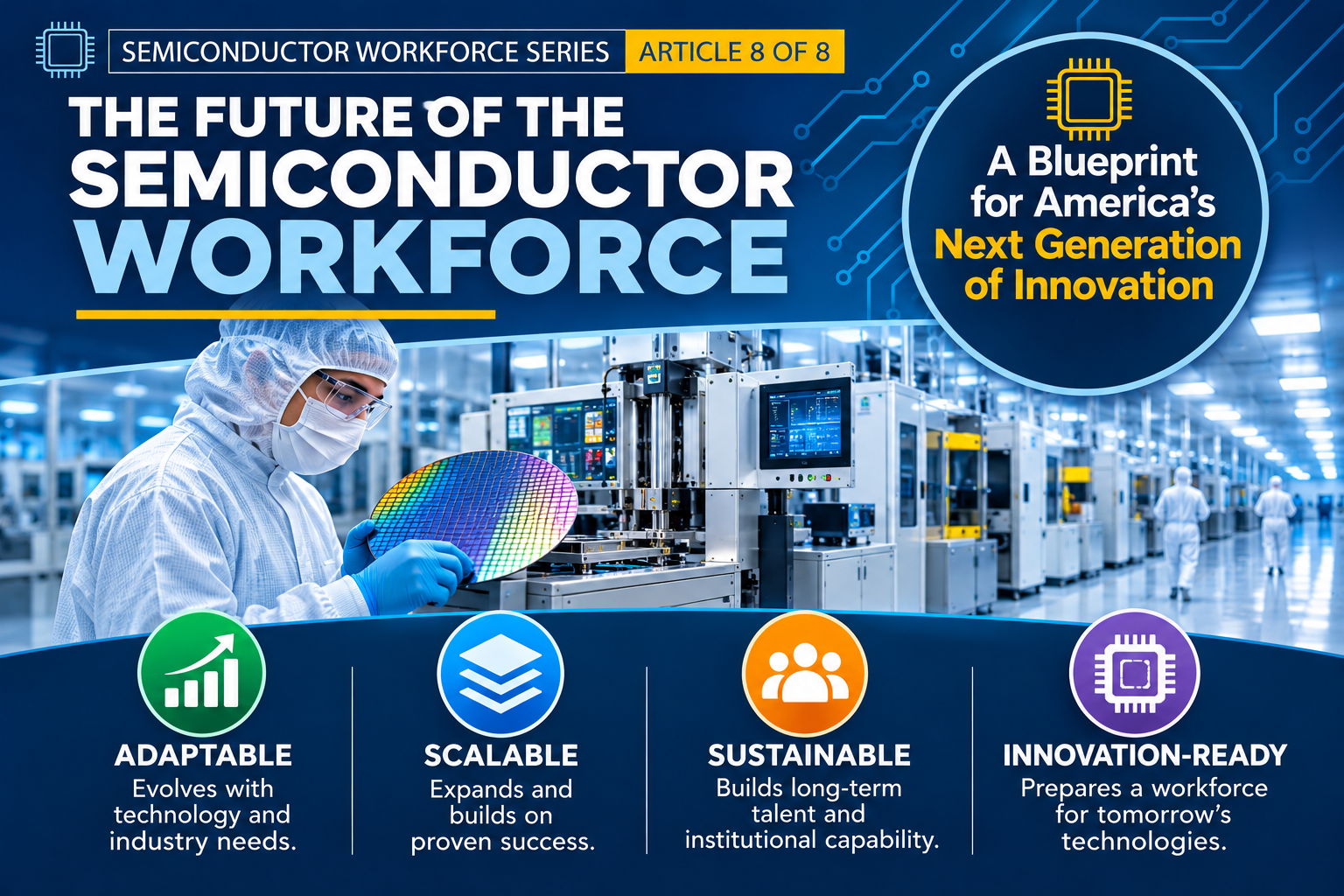
America’s semiconductor workforce strategy must be built for an industry that will never stop changing. The next challenge is not simply expanding programs or preparing more workers, but developing a workforce system capable of adapting, expanding, and renewing its capabilities as industry evolves. Long-term success will depend on making workforce development a permanent part of semiconductor strategy rather than a temporary response to today’s needs.
What Must America’s Semiconductor Workforce Strategy Accomplish?
Throughout this series, we have examined semiconductor workforce development at different points along the journey, from introducing people to technical careers to preparing, developing, connecting, and investing in the talent the industry requires. The final challenge is larger than any one of those activities. America must turn these individual efforts into a workforce system capable of supporting an industry that will continue changing long after today’s facilities are completed and current workforce initiatives have run their course.
That requires looking beyond immediate workforce needs. A strong strategy must prepare for growth without assuming that today’s technologies, occupations, or requirements will remain unchanged. It must develop new talent while strengthening the existing workforce, respond to regional differences, and adjust as employers discover capabilities they did not anticipate needing. No strategy can predict every technological development or emerging occupation. The objective is to build a system that responds when those changes occur.
Key Takeaway
The strongest workforce strategy is one that can adapt when the future arrives, even when it cannot perfectly predict it.
Why Must Workforce Capacity Grow Alongside Manufacturing Capacity?
Manufacturing capacity can be planned around facilities, equipment, production requirements, and project schedules. Workforce capacity develops differently because technical knowledge, experience, leadership, and institutional capability accumulate over time. If workforce development consistently follows manufacturing expansion rather than developing alongside it, each period of growth risks creating another urgent search for talent.
The better objective is to create enough depth that expansion does not require starting over. Regions should be able to build on existing educational programs, industry relationships, workforce resources, and development systems. Workforce capacity should therefore reflect more than the number of people available for today’s positions. It should include the ability to expand successful programs, redirect resources, develop new capabilities, and respond to changing demand.
Industry Insight
America should not have to rebuild its workforce strategy every time the semiconductor industry enters a new phase of growth.
Workforce development becomes more valuable when each period of expansion strengthens the foundation for the next.
How Can America Build a Workforce System That Adapts to Change?
The semiconductor workforce of the future will develop alongside technologies and manufacturing approaches that cannot all be predicted today. Artificial intelligence, increasingly intelligent automation, advanced sensing, new materials, and more sophisticated process control will continue changing how work is performed. Some responsibilities will become more automated, while others will become more technical. New combinations of knowledge will also emerge.
A future-ready workforce system cannot rebuild programs from the ground up every time technology advances. It needs ways to recognize change early and translate it into workforce decisions by examining how occupations are evolving, where new capabilities are emerging, which existing skills remain transferable, and where additional development is required. The emphasis shifts from preparing people for a fixed set of jobs to maintaining a workforce capable of adapting to the industry.
Workforce Perspective
Future readiness does not mean knowing exactly what tomorrow’s jobs will look like. It means creating a workforce capable of developing as those jobs change.
What Does It Mean to Build a Workforce System That Can Scale?
America’s semiconductor expansion requires workforce capacity across regions with very different educational, economic, and industrial resources. Scalability, therefore, should not mean copying a single workforce model everywhere. It should mean identifying successful approaches that can be expanded or adapted while allowing regions to build upon their own strengths.
One region may have a strong community college network, while another may have exceptional career and technical education programs. Other regions may benefit from universities, apprenticeships, military talent, or an established advanced manufacturing base. The opportunity is to understand why successful programs work and apply those lessons where they make sense rather than continually reinventing solutions.
Key Takeaway
A national workforce strategy does not require every region to look the same. It requires every region to become better at turning its existing strengths into workforce capability.
That is how isolated workforce initiatives begin to become something larger: a system capable of learning, adapting, and expanding alongside America’s semiconductor industry.
How Can America Turn Workforce Development into a Lasting Capability?
The greatest test of America’s semiconductor workforce strategy may come after today’s urgency fades. New facilities and immediate workforce needs naturally attract attention, but semiconductor manufacturing is not a short-term industrial project. The facilities being built today are intended to operate for decades. Technologies will continue to advance, and new generations of employees will enter the industry long after current workforce initiatives have ended.
A sustainable strategy must therefore make workforce development part of the permanent infrastructure surrounding semiconductor manufacturing. The goal is not to preserve every program indefinitely. Programs should expand, evolve, or change as needs shift. What must remain is the ability to recognize emerging requirements and respond to them. That means evaluating results, learning from successful approaches, identifying weaknesses, and continually improving the system rather than rebuilding it whenever a new challenge appears.
Industry Insight
The objective is not to create workforce programs that last forever. It is to create a workforce system capable of continuously building the next thing.
Sustainability does not mean preserving the status quo. It means preserving the ability to change.
What Role Will Tech-Labs Play in the Workforce of Tomorrow?
For more than forty-five years, Tech-Labs has worked alongside educators, manufacturers, workforce organizations, government agencies, and technology partners as technical education has evolved through multiple generations of industrial change. Throughout that time, technologies that once represented the future became standard, new industries created different workforce requirements, and educational institutions adapted to prepare students for opportunities that did not previously exist.
The semiconductor workforce represents another chapter in that evolution. Our role is not to predict every technology students will encounter or every occupation the industry will create. Our role is to help educational institutions and workforce partners build learning environments that can evolve as those requirements change. By connecting education with relevant technologies, supporting instructors, and helping organizations focus on the capabilities they are ultimately trying to develop, Tech-Labs can help prepare learners for both the industry that exists today and the changes that will shape it tomorrow.
Conclusion
Across this eight-part series, we have examined semiconductor workforce development from many perspectives, but each perspective leads to the same larger conclusion: America needs more than individual workforce initiatives. It needs a workforce system capable of developing people continuously as technologies, occupations, and industry requirements change.
Such a system will never be finished because the industry it serves will never stop evolving. The future will depend less on predicting every skill or job that comes next and more on creating the capacity to respond as those needs emerge. If workforce development becomes a permanent component of semiconductor strategy, each generation can begin from a stronger foundation than the one before it.
One Final Thought
At the beginning of this series, we asked a simple question about America’s semiconductor expansion: Who will operate the facilities we are building? That question established the challenge behind this entire series. Building fabs creates manufacturing capacity, but people ultimately determine what America can do with it.
The answer will not come from a single company, school, government agency, workforce organization, or generation of workers. It will come from a system that continually introduces people to opportunity, develops their capabilities, responds to change, and prepares the next generation to carry the work forward.
America has an opportunity to build more than semiconductor manufacturing capacity. It can build the human capability required to sustain that capacity, improve it, and eventually pass it on to another generation prepared to take it further. Technologies will change, facilities will change, and the work itself will change, but one principle will remain constant:
The future of semiconductor innovation will ultimately depend upon the people prepared to create it.
Frequently Asked Questions
A long-term strategy should create the capacity to respond as semiconductor technologies, occupations, and workforce requirements change. Rather than focusing only on current needs, it should help regions continually develop, evaluate, adapt, and expand workforce capability.
Programs cannot predict every future technology. They can build durable technical foundations while maintaining the ability to update instruction as equipment, processes, and occupations change. Future readiness depends as much on adaptability as on knowledge of current technology.
A scalable system can increase workforce capacity without requiring every region to use the same model. Communities can build on their existing educational institutions, employers, workforce resources, and regional strengths while adapting successful approaches to local conditions.
Sustainability requires maintaining the ability to identify changing needs, evaluate outcomes, adjust programs, and develop new capabilities. The objective is not to preserve individual initiatives forever, but to maintain a workforce system that can evolve with the industry.
Adaptability will be one of its defining characteristics. America will need people and institutions capable of learning, responding to technological change, and developing new capabilities as the industry evolves. The strongest workforce system will become more capable with each generation rather than repeatedly starting over.