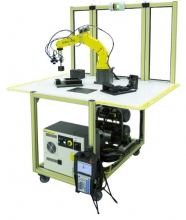
The NEW FANUC LR Mate 200iD/4S Fenceless CERT Cart was developed from combining FANUC DCS Position and Speed Check software with an Allen Bradley SafeZone Mini Safety Laser Scanner. The result is FANUC’s NEW Fenceless Cart that will still fit through a standard door and runs off 110V power. The Fenceless cart allows a greater work envelope and introduces students to the latest in integrated safety products from FANUC and Allen Bradley.
DAC Worldwide's mechanical drives cutaways offer a unique view inside common components. This enhances the training by increasing an individual's understanding of how these devices perform their function.
DAC Worldwide's oil production cutaways offer an inside look at many components commonly found in the oil industry. This wide range of cutaways include a LACT unit, relief valve, check valve, regulator, hammer union, and many more.
DAC Worldwide's process control and instrumentation cutaways offer an inside look at many components commonly found in the manufacturing environment. These cutaways are the perfect addition to training courses and for display purposes.
DAC Worldwide's process control and instrumentation cutaways offer an inside look at many components commonly found in the manufacturing environment. These cutaways are the perfect addition to training courses and for display purposes.
DAC Worldwide's electrical & electronics dissectibles offer the perfect solution when you wish to see the interior of a component. These dissectibles showcase the inner workings of common industrial components.
DAC Worldwide's pumps, compressors, and valves cutaways are valuable additions to training programs by providing an inside looks to these components that are used in almost every industry.
DAC Worldwide's heat transfer & steam models give a unique look at components and systems that are typically only available via illustrations. These models provide a visual that generates interest and promotes learning.
DAC Worldwide's mechanical drives models are great for training and for display. Our Kingsbury bearing models is the perfect additional to a training course to discuss the operation of hydrodynamic thrust bearings.
DAC Worldwide's oil production models provide a great visual to increase understanding and awareness of how these systems work. They are a great addition to a training program or for display in a facility's public areas to draw interest.
DAC Worldwide's process control and instrumentation dissectibles are a great addition to training course. This series of meters, indicators, & gauges provide hands-on skills in disassembly, inspection, and assembly.
Pages
-
-
 Item Number:FLTSimlog's Forklift Personal Simulator puts trainees at the controls of a typical factory forklift with rear-wheel steering. Challenging training scenarios reproduce the productivity demands of modern factory, warehouse, and distribution center environments. Our intelligent Instructional Design will guide your trainees through a series of 7 skill-building Simulation Modules that emphasize safety in every exercise.
 -
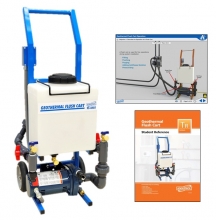 Item Number:95-GEO3Amatrol’s Geothermal Flush Cart Learning System (95-GEO3) teaches how to purge debris and air from the geothermal loop and then charge it with a glycol/water solution
 -
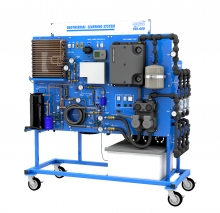 Item Number:950-GEO1Amatrol’s 950-GEO1 Geothermal Energy Training System enables learners to understand and apply their newly obtained technician skills in the ever-growing area of geothermal energy.
 -
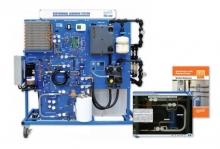 Item Number:950-GEO1DAmatrol’s 950-GEO1 Geothermal Energy Training System enables learners to understand and apply their newly obtained technician skills in the ever-growing area of geothermal energy.
 -
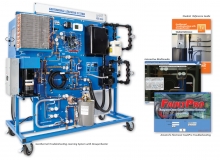 Item Number:950-GEO2DAmatrol’s 950-GEO2D Geothermal Troubleshooting Learning System with Desuperheater uses an exposed component layout so that learners can see each component’s role in a geothermal system.
 -
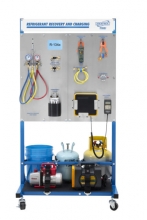 Item Number:T7031With Amatrol’s Refrigerant Recovery and Charging Learning System for R-134a, you can train future HVAC/R technicians hands-on the critical technical skills required for a successful career. Students will work with real equipment, including a recovery machine, manifold gauges, submersible cooler, temperature probe, filter dryer, low side liquid charger, vacuum pump, and micron vacuum gauge.
 -
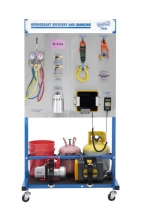 Item Number:T7032Teach aspiring HVAC/R technicians the critical technical skills needed to succeed on the job with Amatrol’s Refrigerant Recovery and Charging Learning System for R-410a (T7032). Students will work with real equipment, including a recovery machine, manifold gauges, submersible cooler, temperature probe, filter dryer, liquid vaporizer, low side liquid charger, vacuum pump, and micron vacuum gauge.
 -
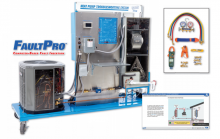 Item Number:T7100Amatrol’s Residential Heat Pump Troubleshooting Learning System (T7100) is used to teach hands-on the critical skills HVAC/R technicians need to succeed when working with residential HVAC systems that use a heat pump and traditional ducting. Students will work with real equipment, including a heat pump condenser, heat pump air handler, Wi-Fi-enabled thermostat, fuse box, ducting, and manifold.
 -
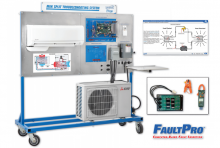 Item Number:T7130With Amatrol’s Residential Mini-Split Heat Pump Learning System (T7130) you can teach the critical hands-on technical skills HVAC/R technicians need when working with residential ductless (“mini-split”) HVAC systems. Students will work with real equipment, including a heat pump condenser, evaporator unit, thermostat, panel-mounted gauges, and condensate pump.