


Hands-on pneumatic troubleshooting training with real-world faults. Amatrol’s 950-PT1 uses FaultPro® to teach pneumatic, mechanical, and electrical system diagnostics.
Stratasys® Diran™ 410MF07 is a nylon-based engineering thermoplastic with 7% mineral fill by weight. It demonstrates exceptional toughness and impact strength and has a smooth lubricious surface with low sliding resistance.
Particularly effective for applications requiring a non-marring interface between the tool and the workpiece, Diran 410MF07 is well suited for jigs, fixtures, and other general manufacturing aids.
System Overview and Compatibility
Diran 410MF07 is currently available on the F370™ and F370®CR 3D printers with 0.007 in. (0.178 mm), 0.010 in.(0.254 mm) and 0.013 in. (0.330 mm) layer heights. It uses SUP4000B™ as a breakaway support system, the only breakaway support offered on the F370 and F370CR. This support material is easier to remove than other Stratasys breakaway support systems. Diran 410MF07 requires the high-temperature build tray and uses a standard F123 print head for the model and support materials. Diran 410MF07 is available on the F370 and F370CR in 90-cubic-inch spools, and SUP4000B is available in the F370 and F370CR standard 60-cubic-inch spools.
Overview of Stratasys FDM 3D Printers and Materials
FDM® (fused deposition modeling) 3D printers offer unparalleled versatility to turn your CAD files into durable parts. These parts are tough enough to be used as advanced conceptual models, functional prototypes, manufacturing tools, and production parts. Engineers can produce various products just by loading different files and materials. No traditional machining process can do that.
Handling & Finishing ABS-ESD7 Parts
Overview
ABS-ESD7 (static dissipative) material is among the many great materials available for the Fortus systems. This paper will walk you through the handling considerations for ABSESD7, including finishing, safety, and packaging guidelines.
Finishing
This material's most common finishing techniques are bonding and smoothing. For smoothing, sanding is the recommended method. As with all FDM materials, standard sanding processes can be followed. Unlike our standard ABS materials, note that this material cannot be smoothed using the finishing touch station. ABS-ESD7 can easily bond through typical methods, including solvents, epoxies, hot-air welding, ultrasonic welding, and superglue.
ABS-ESD7™ (acrylonitrile butadiene styrene-electrostatic dissipative) is an ABS thermoplastic with static dissipative properties suited for static discharge-sensitive applications. ABS-ESD7 prevents static electricity buildup, so it will not produce a discharge or attract other materials like powders, dust, and fine particles.
The material is ideal for jigs and fixtures used to fabricate and assemble electronic components and associated production line and conveyor parts. It is also useful for producing functional prototypes, enclosures, and packaging.
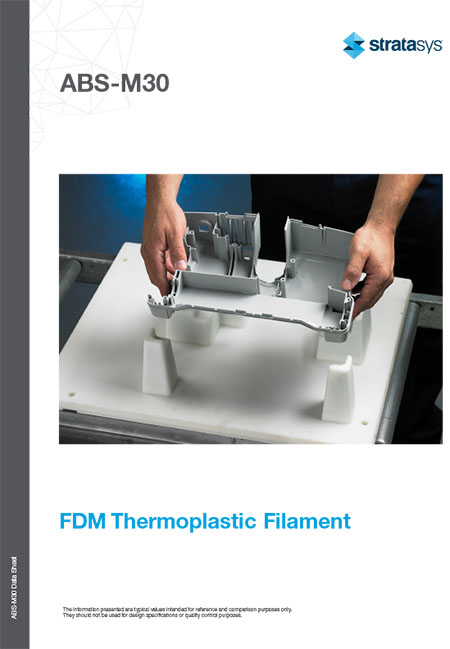
ABS-M30™ filament combines the design freedom of FDM® technology with the versatility and capability of ABS (acrylonitrile butadiene styrene). ABS is characterized by its strength and toughness, while being lightweight and resilient, suitable for most general-purpose 3D printing use cases.
ABS-M30i is a high-strength material well-suited for the medical, pharmaceutical and food packaging industries. Parts manufactured with ABS-M30i material are biocompatible (ISO 10993)* and can be gamma or EtO sterilized. In addition, ABS M30i has passed ISO 18562 testing for gas and airway parts for use in respiratory and ventilation medical devices. When combined with Fortus® 3D Printers, ABS-M30i gives you biocompatible parts with excellent mechanical properties well suited for conceptual modeling, functional prototyping, manufacturing tools and production parts.
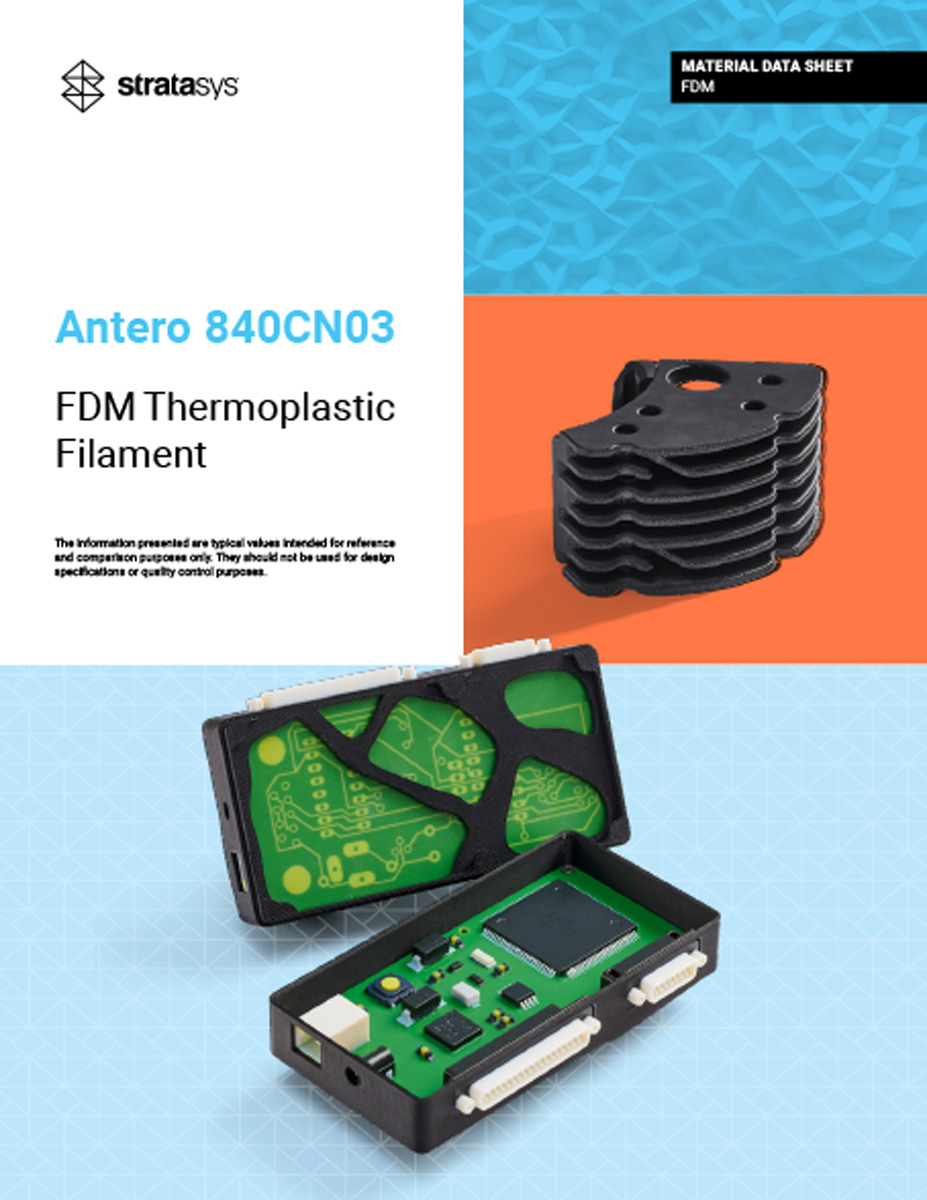
Antero™ 840CN03 is a PEKK-based FDM thermoplastic combining the excellent physical and mechanical qualities of PEKK with electrostatic dissipative (ESD) properties. The material is filled 3% by weight with carbon nanotubes.
As a high-performance polymer, Antero 840CN03 exhibits exceptional chemical and wear resistance, ultra-low outgassing properties and consistent ESD performance. ESD values range from 104 – 109 ohms per square inch. This makes the material particularly suitable for space and industrial applications where these qualities are critical.
Antero™ 840CN03 is a high-performance PEKK-based FDM® thermoplastic with strong mechanical properties and exceptional material properties, such as electro-static dissipation, temperature resistance, chemical resistance, exceptional wear properties, and ultra-low outgassing. This makes it ideal for low-volume, highly-customized production parts and functional prototypes that must withstand more intemperate conditions. Antero 840CN03’s primary advantages over other Stratasys high-performance materials – such as ULTEM™ 9085 resin, ULTEM™ 1010 resin, and PPSF – are its ESD, high chemical resistance, and low outgassing properties.
System Overview and Compatibility
Antero 840CN03 is available on the Stratasys F900™ and Fortus 450mc™ with a 0.010 inch (0.254 mm) slice height. It uses SUP8000B™ as a breakaway support system, similar to other Stratasys high-temperature material offerings. This support material is easier to remove than the other breakaway support systems. Antero 840CN03 requires the hardened head upgrade and utilizes a custom T20F tip for the model material. Both systems use a standard T16 tip for the support material.
Antero 840CN03 and SUP8000B are available in standard 92.3 cubic inch Fortus Plus™ canisters only, and the material will use the existing high-temperature material build sheets.
Antero™ 800NA is a PEKK-based FDM® thermoplastic. It combines FDM’s design freedom and ease of use with the excellent strength, toughness, and wear-resistant properties of PEKK material.
Antero 800NA exhibits high heat resistance, chemical resistance, low outgassing, and dimensional stability, particularly in large parts.
Appropriate applications include aircraft components exposed to jet fuel, oil, and hydraulic fluid, spacecraft parts that demand low outgassing, and chemical-resistant industrial parts. Using Antero 800NA with FDM technology avoids the waste associated with subtractive manufacturing of high-cost bulk PEKK material.
Antero 800NA is available on Fortus 450mc™ and F900™ 3D Printers and is compatible with breakaway support material SUP8000B™.
ASA (acrylonitrile styrene acrylate) FDM® filament is a broad-use commodity thermoplastic. It is similar to ABS (acrylonitrile butadiene styrene) but exhibits better UV resistance, mechanical properties, and aesthetics than ABS.
ASA suits most general-purpose 3D printing applications involving prototyping, jigs and fixtures, and low-volume production parts. ASA filament is available in the most colors of any FDM material.
Pages
-
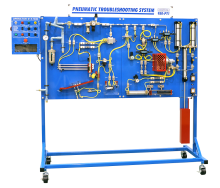 Item Number:950-PT1
 -
 Item Number:27-PNA1Amatrol’s Pneumatics 1 Assessment Workstation (27-PNA1) features a compact workstation designed to effectively assess hands-on pneumatics skills with a variety of industry-standard components.
 -
 Item Number:990-DRV1FAmatrol's 990-DRV1F features industry-standard components like a Rockwell PowerFlex 4 variable frequency AC drive and a 3-phase AC motor used to teach the fundamentals of configuring and operating an AC drive. The 990-DRV1F uses FaultPro, Amatrol’s electronic fault insertion, to teach motor drive troubleshooting skills, such as drive input, motor input, and drive relay troubleshooting.
 -
 Item Number:990-ACDC1With the 990-ACDC1 learning system, you can teach the basics of AC and DC electrical systems in industrial, commercial, agricultural, and residential applications. The system offers industry-relevant skills including how to operate, install, design, and troubleshoot fundamental AC and DC electrical circuits for various purposes.
 -
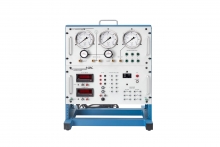 Item Number:616-000DAC’s Portable Calibration Training System (616-000) is a portable tabletop instrument calibration workstation that allows for convenient testing and calibration of instruments, process controllers, and other instrumentation and process control-related components.
 -
 Item Number:990-MC1FSL
Amatrol’s Portable Electric Motor Control Troubleshooting Training System (990-MC1FSL) features typical industry components like a 3-phase AC squirrel cage motor. It uses 3-phase AC for power and 24 VDC for control, all packed within a space-saving, portable product. The real-world motor control components will prepare learners for work in industries where electric relay control applications are used, like conveyor control and driving large utility pumps. Teach students how to read and interpret ladder diagrams.
-
 Item Number:990-EC1FAmatrol’s Portable Electric Relay Control Troubleshooting Training System (990-EC1F) covers concepts widely used in industrial, commercial, and residential applications to regulate electric motors and fluid power actuators, as well methods used for troubleshooting problems in relay control components and systems.
 -
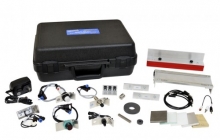 Item Number:990-SN1Amatrol's 990-SN1 includes various electronic sensors, such as capacitive proximity, inductive proximity, magnetic reed, hall-effect, and photoelectric. These sensors can be used with a provided test materials to teach how each sensor completes industrial tasks. Combined with Amatrol’s curriculum, this innovated tool provides a thorough understanding of electronic sensor applications.
 -
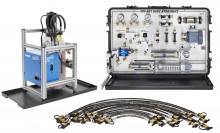 Item Number:990-BH1Amatrol’s Portable Basic Hydraulics Learning System allows learners to gain skills by studying basic hydraulic circuits, pressure control circuits, hydraulic schematics, and sequence valves. The system includes a robust, portable case, eLearning curriculum, and student reference guides.
 -
 Item Number:990-PC1Amatrol’s Portable Process Control Troubleshooting Learning System – Level & Flow (990-PC1F) provides a skill-rich, portable troubleshooting training system for two of the most common types of process control systems, flow and liquid level.