


The OnRobot VGC10 electrical compact universal robot vacuum gripper has unlimited customization possibilities. Smaller than the VG10, the VGC10 can fit into tight environments to extend your automation possibilities.
ULTEM™ 9085 resin is a thermoplastic resin manufactured by SABIC Innovative Plastics. As you know, with all the other FDM thermoplastics the resin manufactures names and resin formulations are highly confidential.
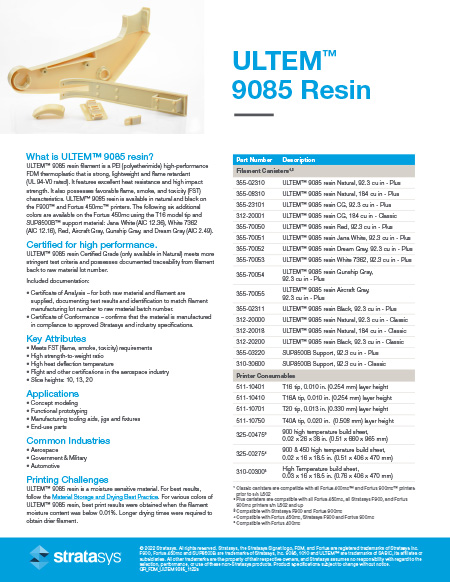
ULTEM™ 9085 resin filament is a PEI (polyetherimide) high-performance FDM thermoplastic that is strong, lightweight, and flame retardant (UL 94-V0 rated). It features excellent heat resistance and high impact strength. It also possesses favorable flame, smoke, and toxicity (FST) characteristics.
ULTEM™ 9085 resin is available in natural and black on the F900™ and Fortus 450mc™ printers. The following six additional colors are available on the Fortus 450mc using the T16 model tip and SUP8500B™ support material: Jana White (AIC 12.36), White 7362 (AIC 12.16), Red, Aircraft Gray, Gunship Gray, and Dream Gray (AIC 2.49).
 The full-color, multi-material Stratasys® J850™ TechStyle™ and J850™ Prime FabriX™ printers powered by 3DFashion™ technology boast the innovative capability of printing 3D designs directly onto fabric. With Stratasys printing materials, combinations of colors, transparency, and flexibility are possible all in one print on different textiles and flexible substrates.
The following sections describe tips, guidelines, and online resources for designers to start 3D printing using Stratasys technologies and materials. With this wealth of information and your experimentation, you will gain the knowledge and skills you need to achieve outstanding results.
Guidelines and Tips
- Tips for Getting Started
- Vector Designs
- Distance Between Elements
- Element Size
- Element Height
- Size Recommendations Table
- Color Assignment
- File Type Support
- Stratasys Online Resources
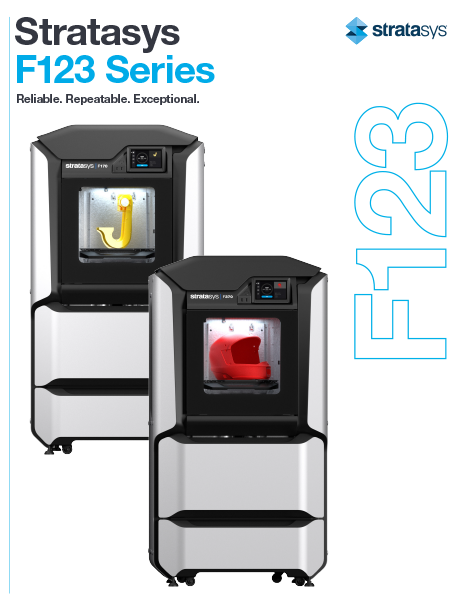
Printer performance and reliability directly impact your bottom line. Stratasys' F123 line of FDM 3D printers is the most accurate compared to various competitors and the fastest, with the least downtime. Confidently print more parts in less time with a Stratasys F123 series FDM 3D printer.
Industry Report: White Paper
Desktop and low-priced 3D printers may seem the logical choice to start with 3D printing. But it’s often the wrong choice because these 3D printers are typically not up to the task nor have the trusted reliability of FDM technology.
This white paper highlights a third-party head-to-head comparison and how each 3D printer fared. Curious to know how F123 Series FDM 3D printers stack up against these competitors?
Download this white paper, evaluate and learn how F123 Series out preforms it's competition.
PPSF/PPSU (polyphenylsulfone) material has the greatest heat and chemical resistance of all Fortus® materials - ideal for aerospace, automotive and medical applications. PPSF parts manufactured on Fortus 3D Printers are not only mechanically superior, but also dimensionally accurate, to better predict end-product performance. Users can also sterilize PPSF via steam autoclave, EtO sterilization, plasma sterilization, chemical sterilization and radiation*. PPSF gives you the ability to manufacture parts direct from digital files that are ideal for conceptual modeling, functional prototyping, manufacturing tools and production parts.
PPSF (polyphenylsulfone) is a high-temperature, high-strength, and chemically resistant FDM material. While ideal for demanding applications, the durability and chemical resistance make finishing PPSF parts with sandpaper or solvents difficult and time-consuming.
When smooth surfaces are needed, hand sanding or milling are the two options most often used. Resistant to abrasion, PPSF makes hand sanding a laborious task that can consume hours. While a finishing pass with a CNC mill can make short work of surface smoothing, it negates many of the advantages of the FDM process. To prepare for machining, time is needed for CAM programming and machine set-ups. Machining also requires that an operator oversees the process.
If PPSF is used to make tools or molds, there is a new and faster alternative for surface smoothing, thermoforming. A thin sheet of plastic is drawn onto the surface of the PPSF part. While it conforms to the part’s shape, the plastic sheet does not transfer the layer lines to the outer surface. To preserve the mechanical, thermal, and chemical advantages of PPSF, the thermoforming process uses sheets of plastic made from PEEK resin. Versus hand sanding, PEEK thermoforming can reduce lead time by 75 percent
and cost by 90 percent (table 1).
More reliable, more affordable, more productive rapid prototyping and manufacturing than ever before.
Stratasys' F123 Series 3D printers give designers, engineers, and educators access to affordable, industrial-grade 3D printing. Work faster through concept iterations and component verification. Make jigs, fixtures, and manufacturing tools faster, with strong, stiff materials. Increase productivity and reach your goals sooner with repeatable results.
30 years of expertise. One leader in FDM.
For manufacturers new to 3D printing and established factory floors alike, Stratasys FDM® 3D printers are the game-changing choice — allowing you to build strong, durable, and dimensionally stable prototypes, tools and production parts with industry-leading repeatability and reliability. Additionally, our experts are well-versed in many global manufacturing methods and ready to help you find ways to shave days off production cycles, meet industry demands and maximize throughput.
Make it with GrabCAD
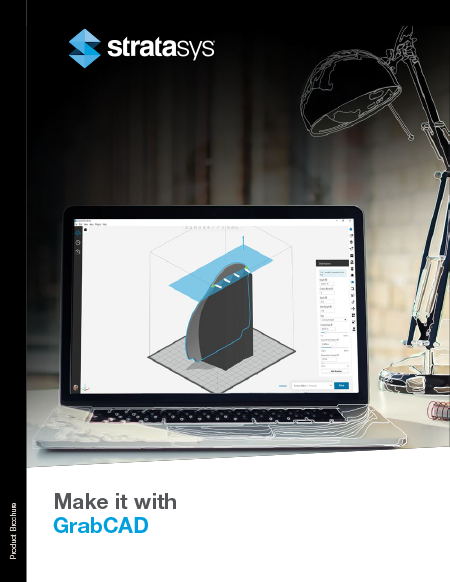
GrabCAD Print™ simplifies the traditional 3D print preparation workflow and provides intelligence around printer technology so your team can get quality prints, faster.
GrabCAD Print Pro™ takes GrabCAD Print to the next level. It reduces the number of prints required to meet a design’s intent. It simplifies process definition and estimation, integrates to partner software and other systems, and automates tasks to optimize workflows.
Together, GrabCAD Print and GrabCAD Print Pro are the ideal solutions for your production and prototyping needs.
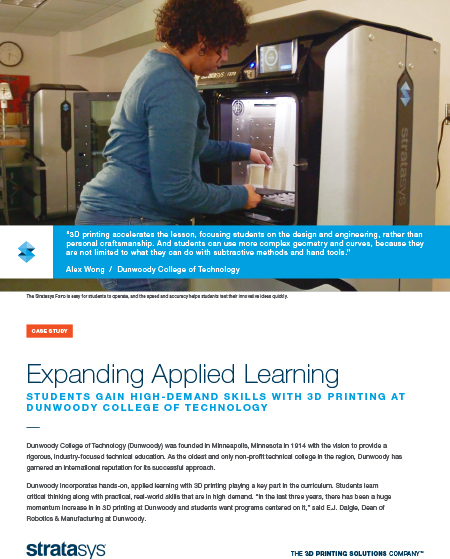
Expanding Applied Learning
Students Gain High-Demand Skills with 3D Printing
Dunwoody College of Technology (Dunwoody) was founded in Minneapolis, Minnesota, in 1914 to provide a rigorous, industry-focused technical education. As the region's oldest and only non-profit technical college, Dunwoody has garnered an international reputation for its successful approach.
Dunwoody incorporates hands-on, applied learning with 3D printing playing a crucial part in the curriculum. Students learn critical thinking and practical, real-world skills in high demand. “In the last three years, there has been a huge momentum increase in 3D printing at Dunwoody, and students want programs centered on it,” said E.J. Daigle, Dean of Robotics & Manufacturing at Dunwoody."
Pages
-
 Item Number:VGC10
 -
 Item Number:VGP20With payloads up to 20kg, the OnRobot VGP20 is a powerful electric powered universal robot vacuum gripper ideal for quickly and cost-effectively automating the palletizing of cardboard boxes, as well as handling bulky, porous, and irregularly shaped objects.
 -
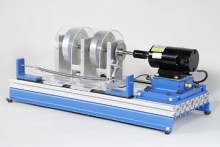 Item Number:203-000DAC Worldwide’s Vibration Analysis Training System (203-000) is a heavy-duty learning package that allows for in-depth training in vibration analysis, using a vibration meter, gear/belt drives, and bearing faults.
 -
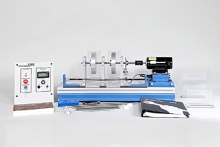 Item Number:203-PACDAC Worldwide’s Vibration Analysis Training System Plus (203-PAC) is a heavy-duty learning package that allows for in-depth training in vibration analysis, using a vibration meter, gear/belt drives, and bearing faults.
 -
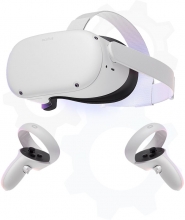 With our Workplace Safety package, you get four modules that allow learners to put safety training into practice in a safe, virtual environment.
 -
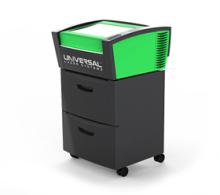 Item Number:VLS 2.30DTThe VLS2.30DT Desktop is a compact and economical entry-level platform. It offers a material processing envelope of 16" x 12" x 4" or 768 in³ and can be equipped with one 10.6µm CO2 laser source ranging in power from 10 to 30 watts or one 9.3µm CO2 30 watt laser source.
 -
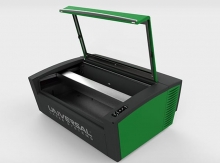 Item Number:VLS3.60DTThe VLS3.60DT is a compact and economical entry-level platform that offers a material processing envelope of 24" x 12" x 4" or 1,152 in³. The VLS3.60DT can be equipped with one of five 10.6µm CO2 laser sources ranging in power from 10 to 60 watts or one 9.3µm CO2 30 watt or 50-watt laser source.
 -
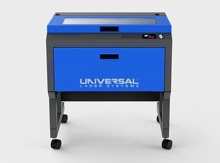 Item Number:VLS3.75The VLS3.75 is a free-standing platform with a materials processing envelope of 24" x 12" x 8.5" or 2,448 in³. The single laser platform supports a 10.6µm CO2 laser source ranging in power from 10 to 75 watts or one 9.3µm CO2 30 watt, 50 watt, or 75 watt laser source.
 -
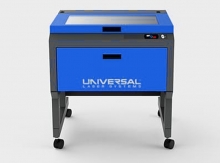 Item Number:VLS4.75The VLS4.75 is a free-standing platform with a materials processing envelope of 24" x 18" x 8.5" or 3,672 in³. The single laser platform supports a 10.6µm CO2 laser source ranging in power from 10 to 75 watts or one 9.3µm CO2 30 watt, 50 watt, or 75 watt laser source.
 -
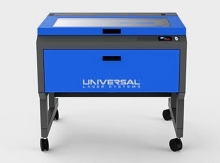 Item Number:VLS6.75The VLS6.75 is a free-standing platform with a material processing envelope of 32" x 18" x 8.5" or 4,896 in³. The single laser platform supports a 10.6µm CO2 laser source ranging in power from 10 to 75 watts or one 9.3µm CO2 30 watt, 50 watt, or 75 watt laser source.