

Amatrol’s High School Learning Systems create the need for students to want to learn math and science – they can’t interact with the exciting technology without it. Learning is interactive and challenging, keeping them engaged and wanting to do more. The math and science so desperately needed for 80% of jobs today is a natural outcome.
FANUC Certified Education Training Solutions
FANUC’s Certified Education Robot Training (CERT) program offers educational institutions and workforce training centers industry-standard robotics and CNC solutions. These systems are designed to prepare students and incumbent workers for high-paying careers in automation, manufacturing, and advanced technologies.
Download the full catalog to view available training carts, standalone robots, add-ons, simulation software, eLearning resources, and more.
- Hands-on robotic carts, including fenceless, enclosed, and tabletop options
- Curriculum-aligned solutions with industry credentials via NOCTI
- CNC Simulators and ROBODRILL training equipment
- Add-ons like iRVision, project kits, and collaborative EOAT
- Detailed training path and instructor certification info
Why FANUC CERT?
- Globally recognized robotics and CNC platforms
- Customizable to your curriculum or program goals
- Access to advanced certification pathways for both students and instructors
- Grant opportunities and institutional pricing available
Ready to implement FANUC training solutions in your program? Contact Us.
Saturday, January 25, 2025
Join us as we recap an incredible ACTE conference in beautiful San Antonio, Texas! This year, we partnered with leading manufacturers and educators to showcase the latest innovations in Career and Technical Education (CTE).
Discover how we’re shaping the future of technical education across Texas and beyond. Don't miss next year’s event in Nashville!
Architectural Engineering Design with 3D Printers, Laser Cutters & CAD
Tuesday, April 8, 2025
Real Tools. Real Experience.
South Texas College (STC) is equipping the next generation of architectural engineers with the same industry-relevant tools used by professionals — all powered by solutions from Tech-Labs.
In their Architectural Engineering Design Technology program, students use cutting-edge technologies to bring concepts to life:
- 3D Printers: Turn digital designs into physical prototypes in hours, not days
- Laser Cutters: Precision cutting for models and materials across design projects
- CAD Software: Professional-level 3D modeling tools for architectural design
- Digital Fabrication Tools: Blending creativity with industry-ready applications
Students don’t just learn theory—they engage with hands-on tools to design, model, and fabricate structures they can touch. These real-world experiences prepare them for high-demand careers in architecture, engineering, and advanced manufacturing.
Bring These Tools to Your Program
We are proud to support institutions like STC by providing the equipment and expertise to build future-ready labs. Whether you’re enhancing an existing space or building from the ground up, we’ll help you bring industry-grade design and fabrication tools to your students.
Contact us to bring 3D printers, laser cutters, and interactive design technology to your program.
Prepare for High-Demand Careers in Automation and Maintenance
Tuesday, April 8, 2025
Maria Olivera, a faculty instructor at South Texas College, shares insights into the college’s Advanced Manufacturing Technology (AMT) and Mechatronics program — a hands-on pathway to becoming a technician in today's high-tech workforce.
This program prepares students for careers in:
- Mechatronics and Maintenance Technician roles
- Automation Development and Systems Integration
- Robotics, PLCs, and AC/DC Circuits
- Fluid Power Systems and Electromechanical Devices
Training with Real Industry Tools
Through a partnership with Tech-Labs, students train using Amatrol industry-standard equipment designed to reflect real-world challenges. This hands-on approach ensures students graduate with the skills employers are looking for.
Versatile Career Opportunities
Graduates are equipped to work in a wide range of industries where automation, robotics, and maintenance play a key role. The training is comprehensive, yet adaptable to meet the needs of today's evolving manufacturing environments.
Tech-Labs is proud to support South Texas College with the latest training systems, helping students build the future of American manufacturing — one skill at a time.
Ready to learn more? Contact Us for more information.
Centralized Training Management for Construction Simulators
Tuesday, August 27, 2024
Real-Time Insights. Custom Paths. Total Control.
In the ever-evolving world of construction and heavy equipment training, CM Labs’ Intellia Instructor delivers the centralized intelligence your training program needs to grow and thrive.
From the job site to the classroom, Intellia Instructor is designed to manage, monitor, and elevate training experiences using simulation-driven data and flexible learning paths.
- Connect and manage an unlimited number of simulators
- Customize training plans to suit your classroom objectives
- Monitor student progress in real-time—on the go, via tablet
- Trigger live hazards and distractions to mimic real job site challenges
- Use on-demand reporting and analytics to identify skill gaps and boost performance
Immersive, Instructor-Friendly, and Fully Scalable
Intellia Instructor is built by engineers and equipment experts, delivering unmatched realism powered by CM Labs’ engineering-grade machine behavior. Trainees work at their own pace while instructors enjoy seamless classroom control and support.
Whether training new operators or upskilling experienced personnel, Intellia Instructor gives you the tools to deliver world-class simulation training in a flexible, scalable, and data-driven environment.
Powered by Vortex Technology
CM Labs' simulation systems, including the Intellia Instructor platform, are backed by decades of experience in simulation and engineering. Their Vortex Studio technology ensures authentic equipment response, accurate physics, and unmatched training realism.
Let us help you take your operator training to the next level with CM Labs simulation solutions. Contact us today to schedule a demo or learn more.
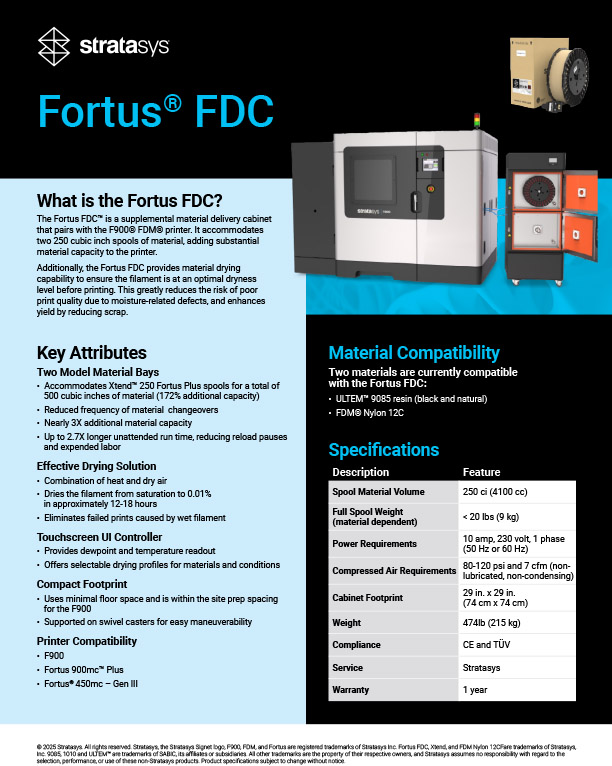
Maximize Your F900 Printer Potential with the Fortus FDC
Download the Fortus FDC™ Quick Reference Guide and learn how this supplemental material delivery cabinet enhances the performance and reliability of your Stratasys F900® FDM® printer.
What is the Fortus FDC?
The Fortus FDC™ is a specialized cabinet that extends the material capacity of your F900 printer with up to two 250 ci spools, nearly tripling available material. Designed with built-in drying technology, it ensures optimal filament conditions to reduce print failures and boost productivity.
Key Benefits
- Massive Material Capacity: Supports 500 ci of material—172% more capacity, enabling up to 2.7X longer run times.
- Drying System: Uses heat and dry air to reduce filament moisture to 0.01% within 12–18 hours.
- Touchscreen Interface: Features drying profiles, dewpoint, and temperature monitoring.
- Compact & Mobile: Small footprint with swivel casters for flexible deployment.
- Compatible Printers: Works with the F900, Fortus 900mc™ Plus, and Fortus® 450mc Gen III.
Compatible Materials
- ULTEM™ 9085 resin (black and natural)
- FDM® Nylon 12CF
Specifications
- Spool Capacity: 250 ci (4100 cc) per spool
- Weight per Full Spool: < 20 lbs (9 kg), material-dependent
- Power: 10 amp, 230V, 1 phase (50/60 Hz)
- Compressed Air: 80–120 psi, 7 cfm, non-lubricated
- Cabinet Size: 29" x 29" (74 cm x 74 cm)
- Cabinet Weight: 474 lb (215 kg)
- Certifications: CE and TÜV compliant
Download your copy today and discover how the Fortus FDC can elevate your additive manufacturing workflow.
Discover the latest in precision engineering and educational innovation with the Denford Product Catalog. Whether enhancing a school STEM lab, outfitting a technical college, or integrating CAD/CAM into your training program, Denford has the CNC and manufacturing tools to match your needs.
What's Inside?
- New MCR 100 CNC Router – Purpose-built for F1 in Schools car manufacturing
- F1 in Schools Primary Class – Engaging STEM learning for students aged 9–11
- Denford’s CNC Machines – Including routers, mills, lathes, and engravers
- Laser and Water Jet Cutters – Versatile tools for advanced material processing
- 3D Scanning & CAM Software – EasySCAN, QuickCAM Pro, LaserCAM, and more
- Complete Education Packages – From curriculum kits to classroom race systems
Why Choose Denford?
- Over 70 Years of Innovation
- Global Educational Reach – Supporting 26,000+ schools in 52 countries
- Hands-On Learning – Tools that transform classrooms into real-world labs
How to Use the Catalog
From compact desktop routers like the MCR 100 to large-format systems like the Router 6600 Pro, the catalog offers detailed specs, features, and educational applications. Simply browse by product type or training need to find the right equipment for your classroom or lab.
Download the Denford Catalog today and explore hands-on STEM and engineering training solutions built for the future.
Micromill Pro & Microturn Pro: Intro to CNC Training
Looking for a safe, reliable, and educational way to teach CNC machining? The Denford Micromill Pro and Microturn Pro offer an ideal introduction to CNC milling and turning for students at the secondary or post-secondary level. These compact machines feature enclosed, interlocking guards and variable spindle speeds, making them a perfect fit for modern classrooms and training labs.
Perfect for the Classroom
With built-in safety features and educational software, these machines are designed for hands-on learning without compromising safety or performance. The compact footprint and optional shared workstation make the Micromill Pro and Microturn Pro an affordable and flexible solution for schools, community colleges, and workforce development centers.
Download the full spec sheet to explore how the Denford Micromill Pro and Microturn Pro can enhance your CNC education program.
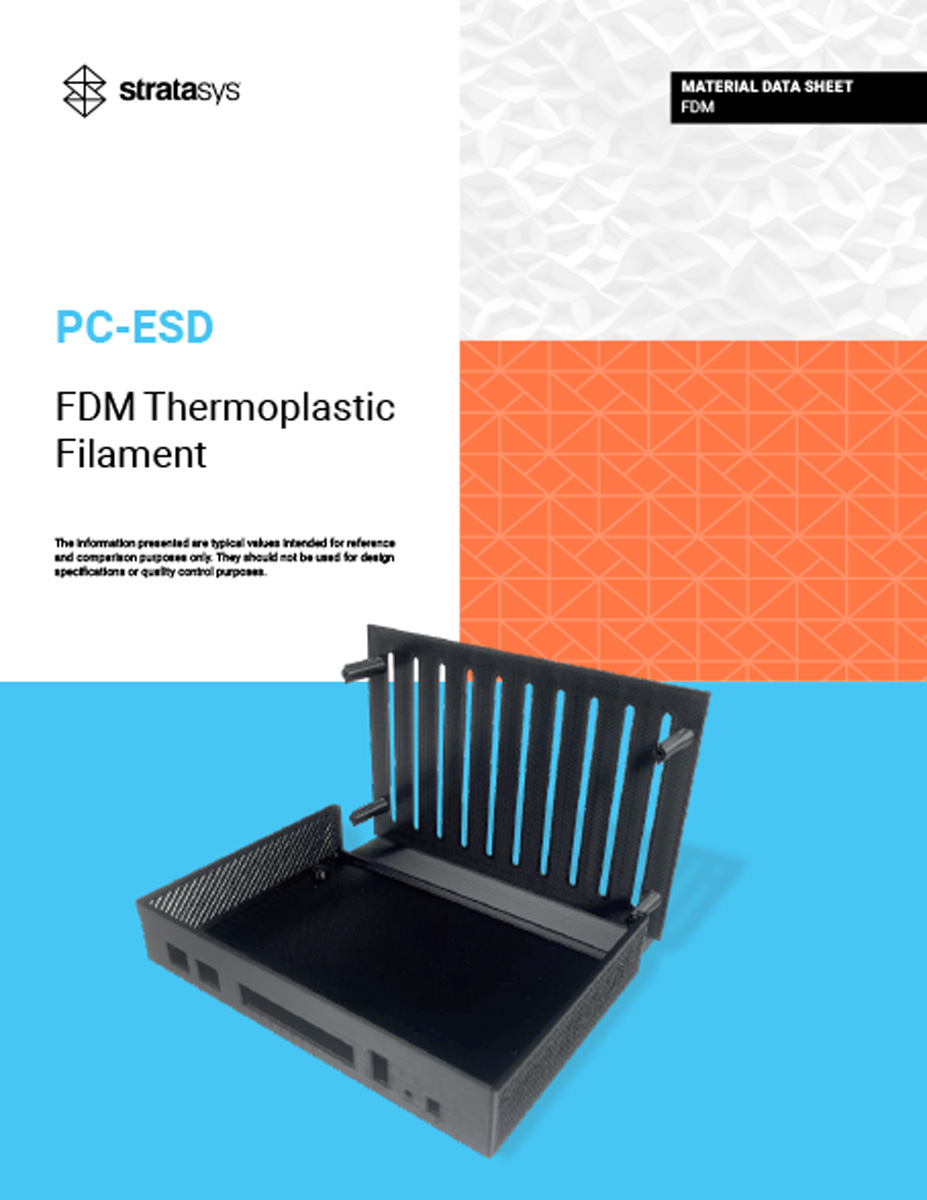
FDM® PC-ESD is a polycarbonate (PC) based material formulated to provide consistent electrostatic dissipative (ESD) performance across different geometries. PC-ESD is a Stratasys-formulated Validated Material for the Fortus 450mc and F900 and can be used in a variety of tools, jigs, fixtures, and assembly aids where ESD performance is critical to ensure that electrical components are not damaged due to static discharge. As a strong, durable, ESD material with a higher allowable usage temperature, excellent mechanical properties, and good chemical resistance, PC-ESD is an excellent material for printed circuit board (PCB) production, electronic manufacturing, and electronic assembly applications.
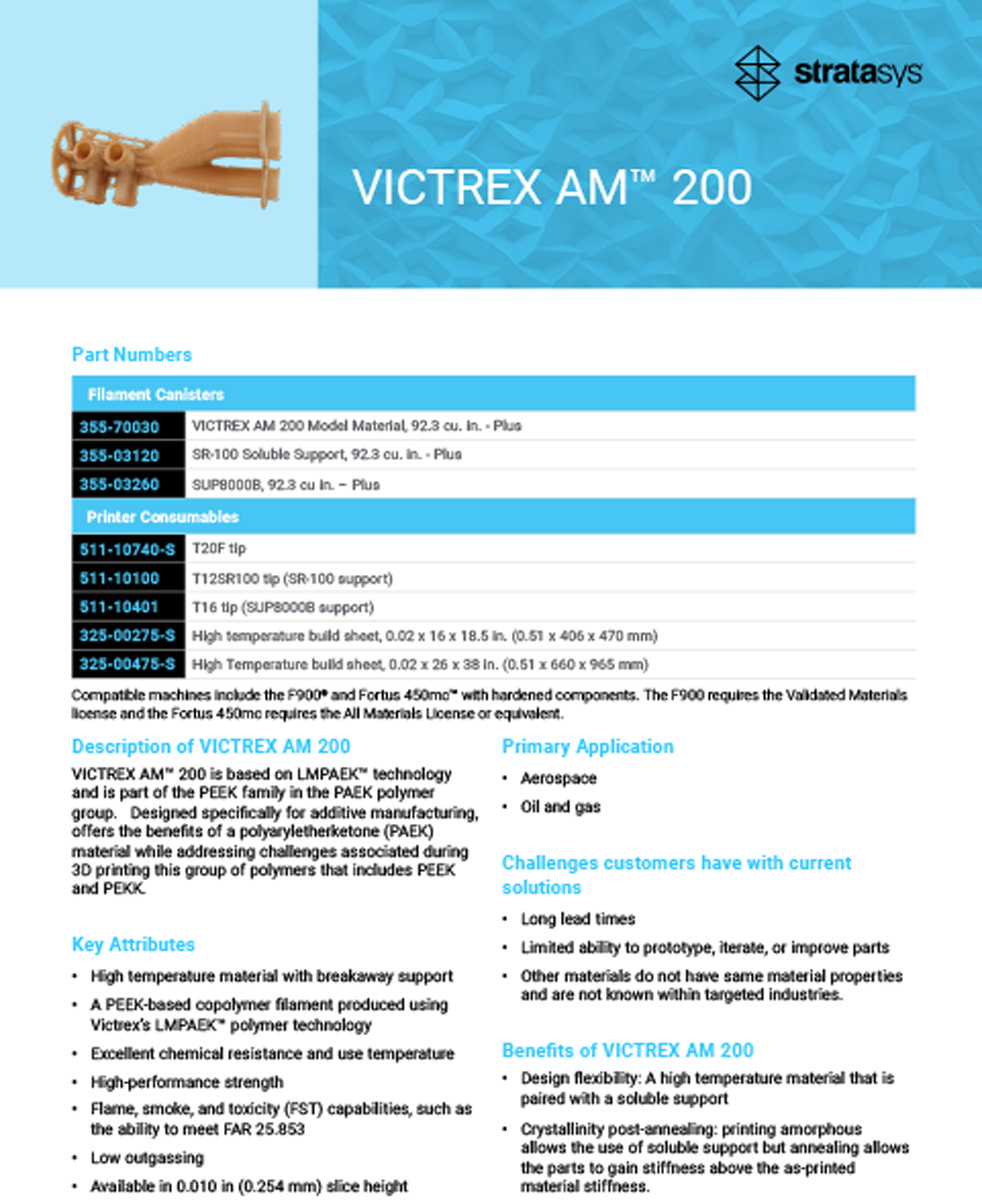
VICTREX AM™ 200 is based on LMPAEK™ technology and is part of the PEEK family in the PAEK polymer group. Explicitly designed for additive manufacturing, offers the benefits of a polyaryletherketone (PAEK) material while addressing challenges associated with 3D printing, this group of polymers that includes PEEK and PEKK.
Pages
-
-
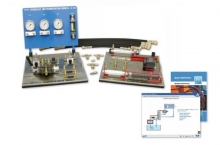 Item Number:BH-85Each Basic Hydraulics training system features standard industrial grade components. This attention to quality gives students experience they would normally only get on-the-job by helping them recognize industrial components and how to troubleshoot them more effectively. Components included with Basic Hydraulics are pre-mounted on circuit panels with silk-screened labels next to each, which facilitates ease of use and identification.
 -
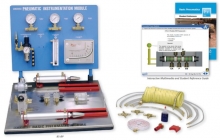 Item Number:85-BPAmatrol’s Basic Pneumatics training system (85-BP) introduces pneumatic principles through a combination of Amatrol’s top-flight multimedia curriculum with hands-on industrial pneumatic skill-building. Topics covered in this learning system include single-acting cylinder circuits, pressure vs. cylinder force, and flow control valves, while the panels can be used to practice skills such as connecting and operating a needle valve to control actuator speed.
 -
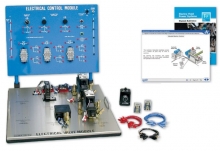 Item Number:85-EHThe Electro-Hydraulics training system includes an electrical control panel with relay control components and an electrical valve module with solenoid-operated hydraulic directional control valves and electrical/electronic sensors. These components will be used to study a variety of topics including electrical control systems, basic control devices, power devices, control relays, sequencing control, timer control, pressure control applications, and circuit applications.
 -
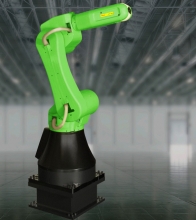 Item Number:CR-35iAFANUC’s new CR-35iA is the world’s first collaborative robot with a payload capacity of up to 35 kg. Fenceless, it opens a whole new world of possibilities. Working safely side by side with human operators, it is space as well as cost saving. And because inside it’s like any other FANUC robot, it operates like all FANUC robots. Certified to meet the requirements of ISO 10218-1:2011 and RIA/ANSI R15.06-2012, FANUC’s CR-35iA collaborative robot can work in a variety of applications alongside human workers including: machine tending, handling heavy payloads that require lift assist devices or custom equipment, higher payload mechanical assembly, palletizing or packing, and tote or carton handling.
 -
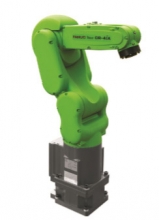 Item Number:CR-4iACR-4iA is a small collaborative robot with 4 kg payload
 -
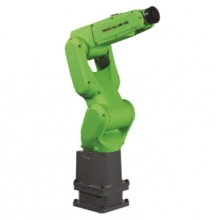 Item Number:CR-7iAThe FANUC CR-7iA is FANUC's newest collaborative robot resembles the LR Mate family. Painted green to show it's ability to work beside humans, you can expect the same reliability as FANUC's yellow robots. The CR-7iA is ideal for small part sorting and assembly, inspection, machine tending, and part delivery. It has a 7 kg payload, 717 mm reach, and is equipped with iRVision and Force Sensing. There are a variety of mounting options such as floor, wall, and ceiling.
 -
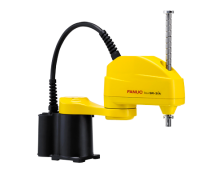 FANUC’s new SCARA robots are ideal for high-speed, precision applications such as assembly, pick and place, testing/inspection and packaging processes.
 -
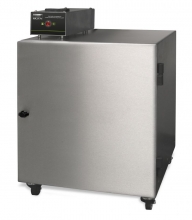
In the rare event that a burning ember or spark is drawn into the fume extraction unit, there is the possibility that debris in the filters could ignite. Although any resultant fire would typically be retained within the fume extraction unit, this would cause significant damage and in extreme circumstances, the risk may extend beyond the extraction unit. For processes where such risks have been identified, additional protection in the form of an in-line firebox is an additional precaution.
-
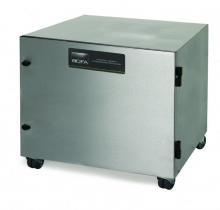
The BOFA inline pre-filter 1000 has been designed specifically for applications that generate high amounts of dust or particulate.
This inline filter unit is positioned alongside the main BOFA fume filtration system to increase the overall filter capacity and extend the life of the main filters. The DeepPleat DUO pre-filter incorporates a massive drop-out chamber within the filter, having a volume area of 15ltrs. Above the drop-out chamber but still within the housing there is a sealed 200mm deep pleat layer of F8 media giving a surface area in excess of 30 sq meters.